
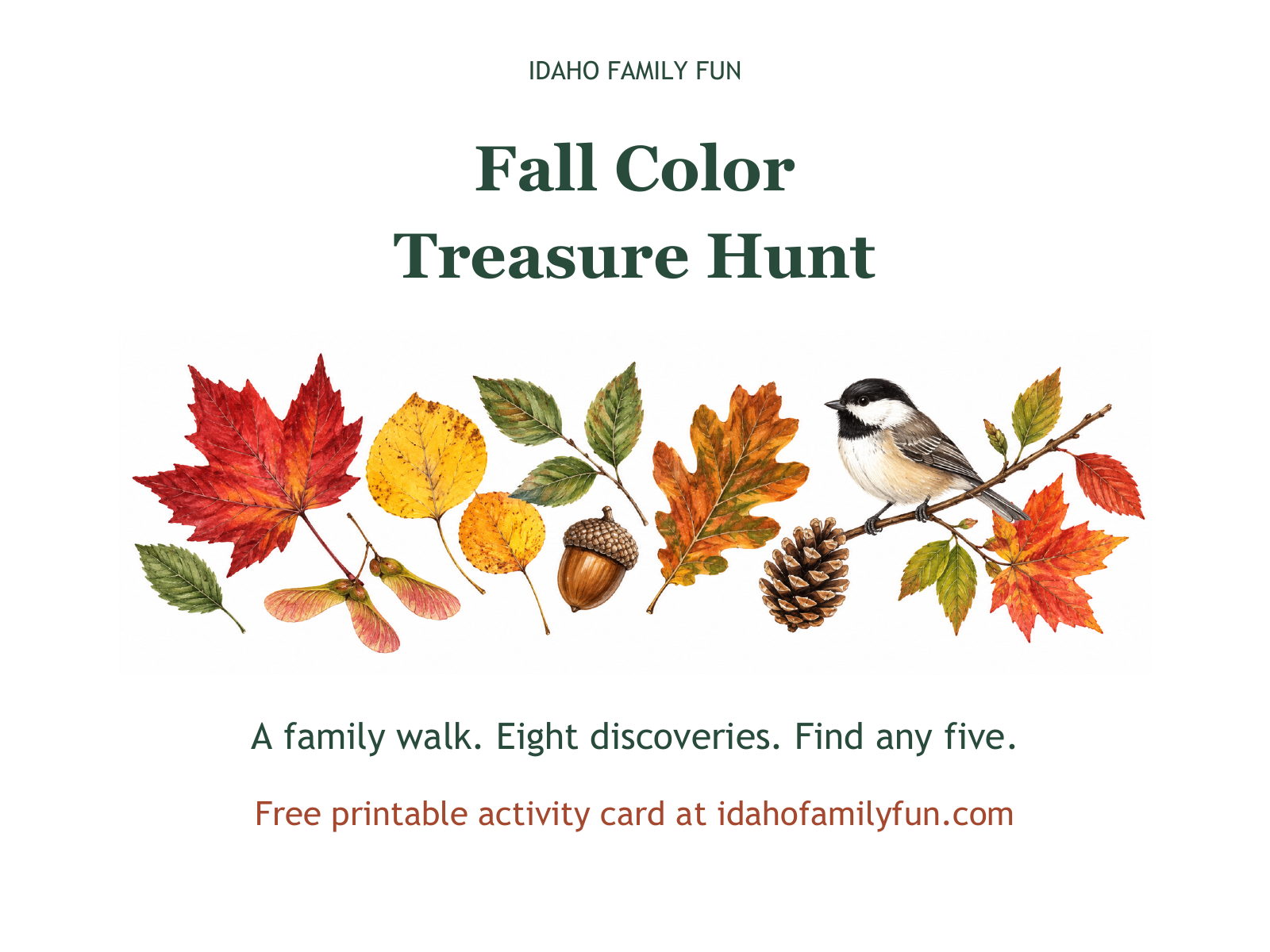
A yellow leaf beside the sidewalk. A seedpod under a park bench. A tree that’s still green while its neighbor turns orange.
Fall gives children plenty to investigate, and a familiar walking path is a good place to start. Give your next family outing a mission: find five small signs of the season.
This treasure hunt works in your neighborhood, at a local park, or at one of the Idaho destinations below. Choose a walk that suits your family, bring a snack, and leave time to stop when something catches a child’s attention.
Download the free Fall Color Treasure Hunt activity card (PDF)
Your fall treasure hunt
Find any five of these eight discoveries. Check them off, sketch them, or take photographs. Leave leaves, seeds, and other natural objects where you find them.
- ☐ A leaf turning yellow, orange, or red
- ☐ Two leaves with different shapes
- ☐ A tree that is still green
- ☐ A fallen leaf smaller than your thumb
- ☐ A leaf with clearly visible veins
- ☐ A seed, cone, or seedpod
- ☐ A leaf moving in the breeze
- ☐ A bird or squirrel visiting a tree
For younger children, begin with three things: a color, a leaf, and a sound. Older children can look for tree labels or sketch a discovery closely enough to show its details.
There’s no need to find everything. If the trees are mostly green, compare their leaves and look for the first hints of change.
Three Idaho places to try
These are a few places to explore, each with a different activity to add to your hunt. Fall color depends on the trees, location, and weather, so these suggestions are not reports of current conditions. Visit Idaho’s fall color guide can help with seasonal planning.
Kathryn Albertson Park in Boise: look for reflections
Ponds and wide, paved footpaths make Kathryn Albertson Park a setting for a slow discovery walk. Boise’s official map describes three-quarter-mile walking loops, and Visit Idaho documents accessible parking and restrooms.
Add a reflection challenge to your treasure hunt. From the path, look for a tree reflected in the water. Can you recognize its colors and shape? What happens to the reflection when the water moves?
The paved paths are a useful option for families bringing a stroller. Keep children close around the ponds, and watch wildlife quietly from a distance.
Plan your visit: Find the park on Americana Boulevard. Check the official walking map and Visit Idaho’s parking and accessibility information before heading out.
Arboretum Park in Eagle: discover a tree’s name
Arboretum Park offers a chance to connect a leaf with the tree it came from. The City of Eagle lists 37 varieties of trees, with identification stakes that include common and scientific names.
Choose a labeled tree, but let the children examine it before reading the name. What stands out: its bark, branches, leaves, or size? Ask them to invent a nickname based on what they notice, then read the label together.
This turns the outing into a tree-identification game, even before much fall color appears. Benches and picnic tables provide places to pause.
Plan your visit: The park is at 312 E. State Street, beside the Senior Citizens Center. Posted hours are dawn to dusk. See the City of Eagle’s park page for visitor information and a parks department contact for questions about access or facilities.
University of Idaho Arboretum and Botanical Garden in Moscow: investigate golden needles
The University of Idaho highlights maples, oaks, ashes, and golden larches among its fall displays. The larches offer an interesting discovery: autumn color can appear on needles as well as broad leaves.
Use the arboretum map and plant labels to look for a larch. If its needles have turned gold, compare it with a nearby tree that is still green. Ask children what they notice before explaining that larches shed their needles seasonally.
Plan your visit: Admission is free, and the arboretum is open daily from dawn to dusk. The south entrance at 1200 W. Palouse River Drive has free parking and a portable restroom near the barn. The main gravel loop is approximately 1.4 miles, with slopes that may be challenging for some strollers and mobility devices. Choose a shorter out-and-back route if that suits your family better.
Explore the university’s seasonal collection highlights and visitor information and maps.
Why do leaves change color?
Leaves contain chlorophyll, the green pigment that helps plants use sunlight to make food. During the growing season, that green masks yellow and orange pigments already in the leaf.
As chlorophyll breaks down in autumn, those colors become easier to see. Some trees also produce pigments called anthocyanins, which contribute red and purple colors.
For children, try this explanation: “Some colors were hiding under the green. Other colors develop as the leaf changes.”
Then look for a leaf with more than one color. Where does it still look green? Where has the color changed?
Read more about the science from the USDA Forest Service and the Smithsonian.
Before you head out
Pack water, a snack, an extra layer, and comfortable shoes. Bring a pencil if your children want to draw. Check current access and restroom information if those details will determine where you go.
Stay on designated paths and watch for bikes on shared routes. A familiar park close to home can be just as rewarding as a special trip. Browse our Family Guides for more places and activities to pair with your walk.
Choose your family’s fall watch tree
Before you finish, ask everyone to share a favorite discovery. Then choose one tree you can easily visit again.
Photograph it from a spot you’ll recognize and let each person predict what will change. Will more leaves turn yellow? Will some branches be bare?
Return the following week, take another picture, and let the children check their predictions.